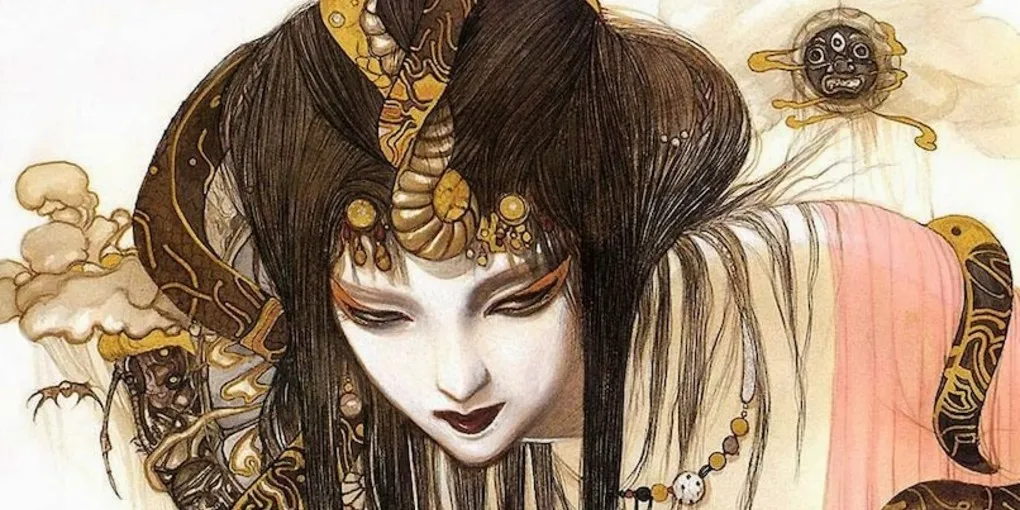
Yoshitaka Amano
The secret to creating a mesmerizing illustration, straight from the mouth of the master…
On his personal journey to become a manga artist, Eiichiro Oda was transfixed by the beauty of Yoshitaka Amano's
Born in Shizuoka Prefecture, 1952. He has provided character and visual designs for a number of anime and video games, such as Science Ninja Team Gatchaman, the Time Bokan series, and the Final Fantasy series, as well as interior illustrations for numerous fantasy novels. He’s also remained highly active in the fine art world. art. After seeing much of Oda’s work, Amano Sensei reveals the secret to his art’s liveliness, as only an artist and illustrator would see it!
Moderator: Let’s kick off this interview between Oda Sensei and one of his biggest inspirations, Yoshitaka Amano Sensei!
Oda: When I was a kid, I watched the Time Bokan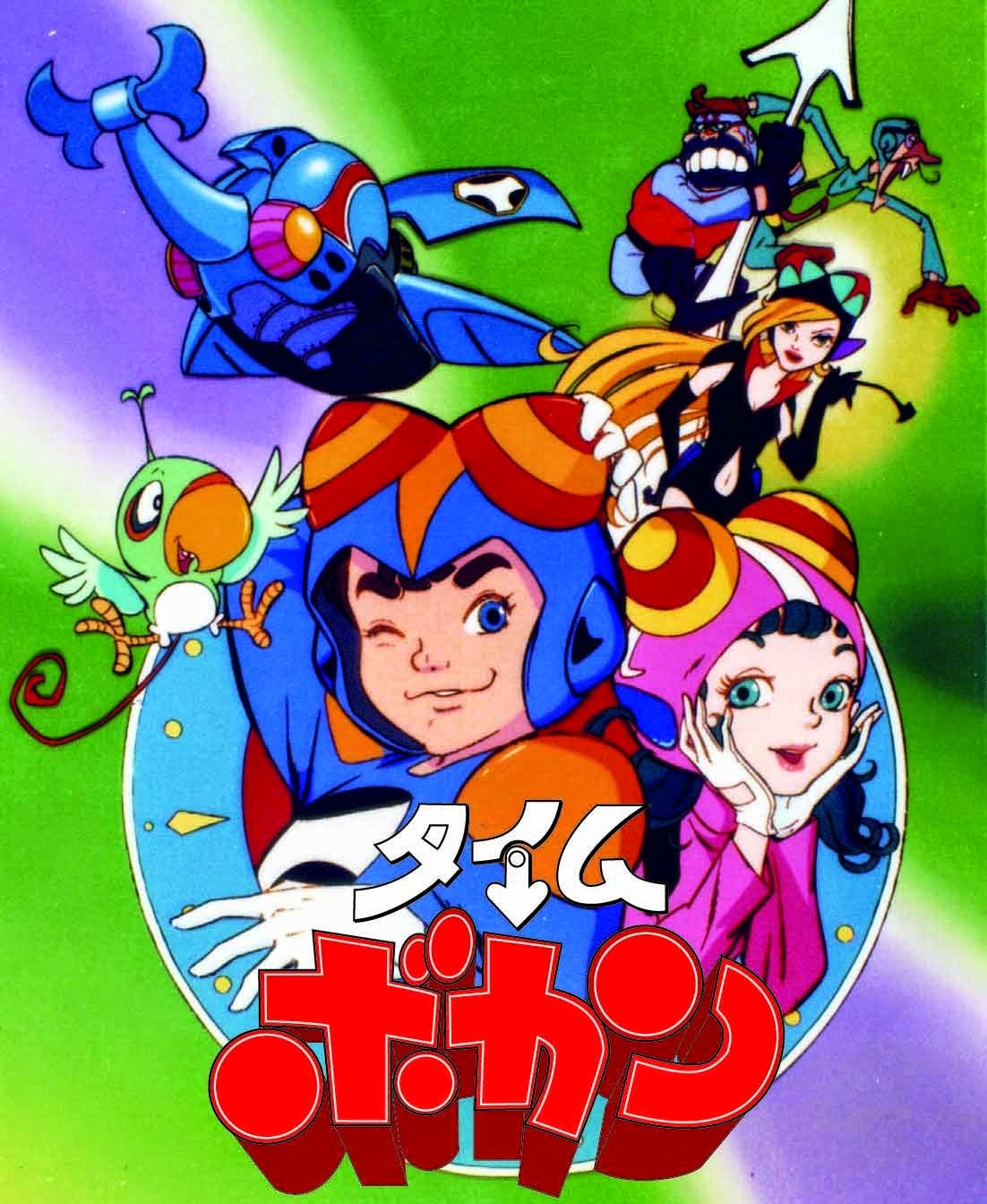 An animated TV series that began in 1975. It’s considered a classic comedy anime. series on TV, which I understand you had a hand in as an animator. You’ve got an incredible personal history. But I wasn’t a fan of yours until I was about twenty.
Amano: Oh, I see.
Oda: My interest began when a friend invited me to check out your gallery exhibition. I was amazed at the beautiful line work — you had this enormous art with the most delicate and precise lines. I’d never seen art with such clean beauty before. I used all the cash I had with me to buy your art collections. I love your kimono illustrations.
Amano: Thank you (laughs).
Oda: Is everything you’re drawing these days in a large format?
Amano: The big stuff is only for exhibitions. I normally use printing paper, so it’s typically tailored to the size of that particular book.
Oda: When you see a piece in person like that, you notice all sorts of details in the coloring that doesn’t come across when printed. It’s quite powerful. So when I look at your art books, I end up imagining the original instead.
Amano: The editors often tell me, “This color won’t show up in print, so use a different paint” (laughs). Or, “Just draw it smaller.”
Oda: Was the reason for making lithographs so that you could more faithfully recreate the original image?
Amano: That’s exactly right. Until that point, my art was only shown to the world through book reproductions. But with a lithograph, it’s just as I painted it. So I always wanted to try that out.
Oda: Is a lithograph like a kind of print?
Amano: That’s right. It’s a method that came one step before what we use in modern printing. I really loved the works of LautrecHenri de Toulouse-Lautrec, a French artist from the late 19th century. He is renowned for many of his lithograph posters. He loved dancers and other decadent women of the night, who often appeared in his works. and Mucha
Alphonse Mucha, a European artist and designer active in the late 19th and early 20th centuries. He is known for his striking Art Nouveau posters and book illustrations, often featuring beautiful women, and they made lithographs. So I went to the same studio in Paris that they used for theirs.
Oda: That’s incredible!
Amano: There, the artist paints each color separately, and the lithographer prints them onto the medium one at a time, until you eventually have the finished piece. Every part is done by hand. So I got to make the images the exact same way they did in the 19th century.
Oda: When I built my house, it was my dream to buy and display one of your huge lithographs. I still haven’t gotten around to that.
Amano: I’ll be here when you’re ready.
Oda: I always wanted to ask you: there was an exhibit you did in Germany where you made a painting of Gatchaman’s eyes right there. You have all these colors pieces that you spend all that time making, so why did you just go and draw a close-up of an eye instead?
Amano: You know, I’m not really sure why.
Oda: Even you don’t know? (laughs) I guess that just makes it fall under the category of “art,” huh?
Amano: I suppose so.
Oda: (laughs)
Amano: I think that art means doing something no one else has ever done. Whatever method I happen to be using, it’s still done by hand, the way it’s been passed down from ages and ages ago. Then Andy WarholAn American artist who came to prominence in the 1960s. He mass-produced pieces of art based on soup cans, celebrity photographs, and comic book characters. His style came to be associated with the term “pop art”, which turned the values of art on its head. came in and decided to make art by manipulating elements that were already there. It was new; nobody ever did that before. I think that’s probably what art means. Sometimes just placing an object somewhere can be art, I guess I don’t really understand in the end. (laughs)
Oda: I really don’t get what makes Warhol so great.
Amano: But it looks pretty on first glance, doesn’t it?
Oda: Hmmm. I don’t think of it as pretty, I think it’s cheating! It’s like, “All you did was photocopy it and change the color palette!”
Amano: That’s right, it is cheating. (laughs)
Oda: I also didn’t understand PicassoOne of the great 20th century artists. He started with realistic portraits in blue palettes, before bursting into wildly original forms of painting. His style change rapidly throughout his life, eventually developing into surrealism. He was a bold pioneer of new techniques, and one of the defining artists of the 20th century. at first, but when I learned that he could paint proper art too, I began to reconsider. To me, an artist has to have the ability to re-create what they see with their own hands. I can’t label anyone an artist otherwise.
Amano: I understand that.
Oda: Your art is good because of an amalgamation of experience and a proper foundation of skill. I think that’s why I feel reassured that I can always enjoy your works.
Moderator: Let’s go the other direction now. Amano Sensei, what did you think when you saw Oda Sensei’s artwork?
Amano: Your art is very entertaining, Mr. Oda. What I felt from your art book was the fact that your viewpoint is contained within the picture. It’s an incredible skill. (Open Color Walk)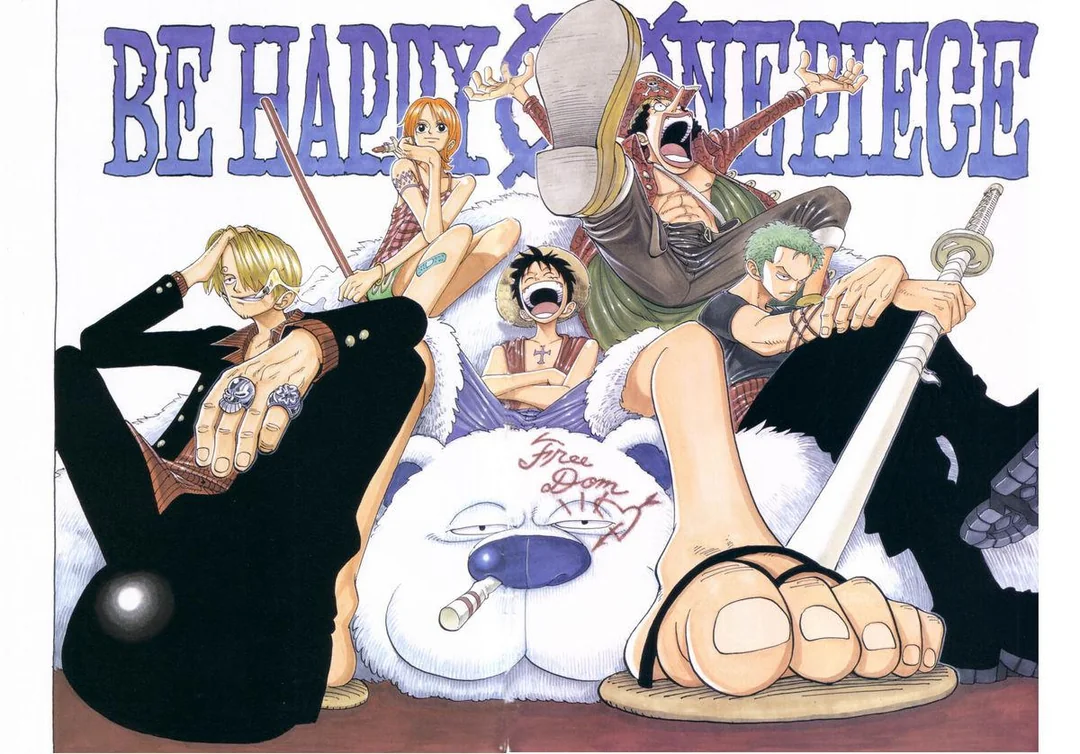 The way the characters overlap, the balance in their poses, there’s a kind of unique depth and three-dimensionality to it. It’s like a pop-up book where the characters jump out at the reader. You don’t see this sort of composition in other works.
Oda: Do you suppose I’m just leaning in too close to the page? (laughs) I’ve never deeply, consciously focused on that sort of thing, but I think it’s a part of my artistic expression. I wonder when I started thinking about it? I’m very careful about distance..
Amano: Ah, yes, I see.
Oda: There are times when I can’t even explain myself to the longest-tenured assistants I have. Distance is such a subjective thing, it’s really hard to describe to others. When you try to match the perspective accurately, it never fits quite right at the end.
Amano: No matter what, you’re faking it. (laughs).
Oda: I can’t calculate and precisely measure the right sizes and ratios of objects, so the only thing I can rely on is my own sensibilities. And when you’re trying to bring your mental image to life, you have to be flexible and creative. Otherwise you can’t draw stuff like this, I think.
Amano: That sense of distance really gives the image power. In the manga, you can feel it in the entire panel. I can sense that in your creative work in the way you create a feeling of distance.
Oda: It’s still a mystery to me.
Amano: (Looking at this illustration)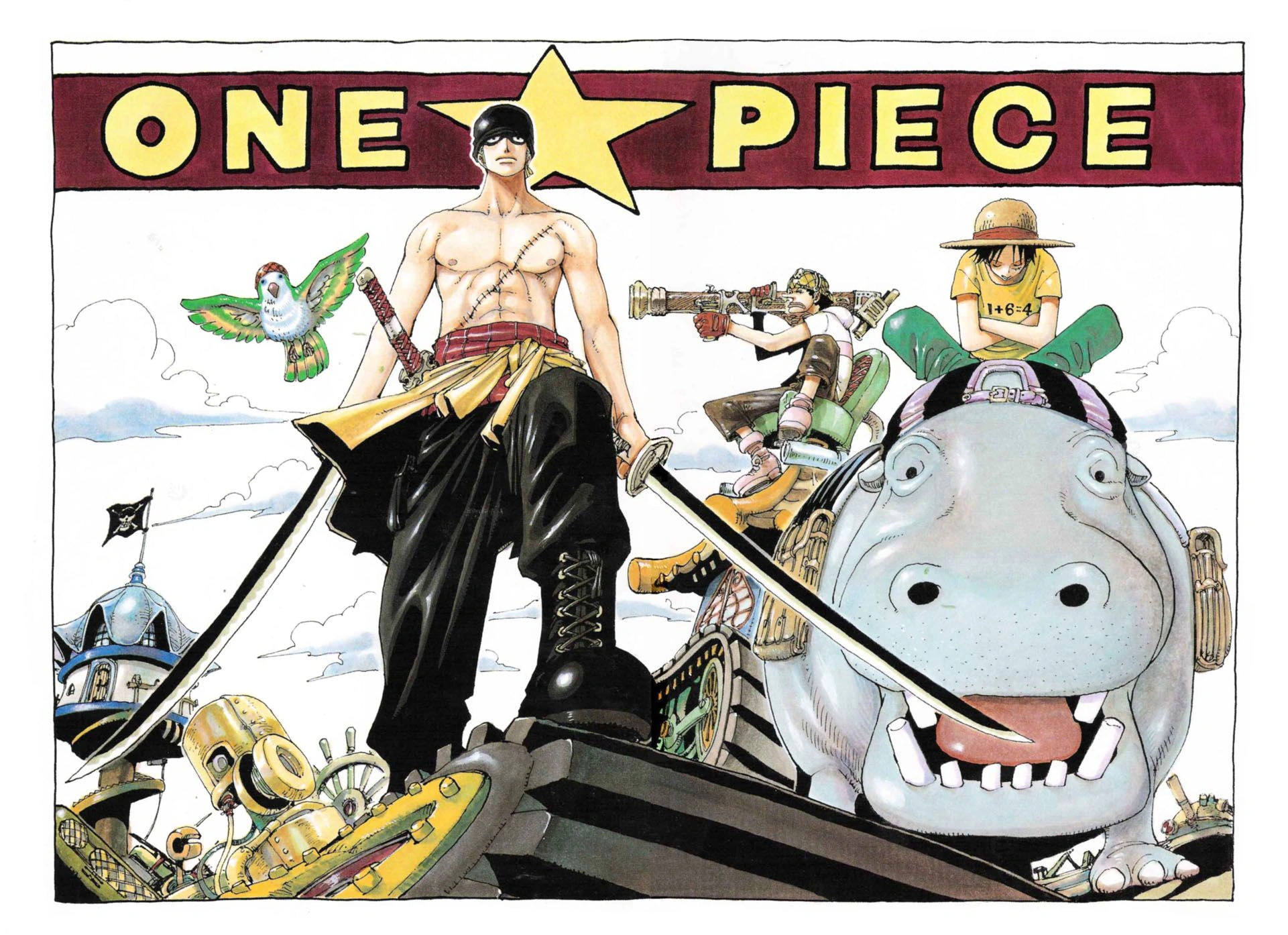 . This one is really cool.
Oda: Thank you! Wow, that’s great to hear! By the way, we’ve got lots of pieces that are nearly rough, like you just went with the first draft. I identify with that practice of not fully drawing to the last step. When you’re drawing with a real rush of emotion, it feels good to see the end result, even if it’s a little shaky around the edges.
Amano: Yes, da Vinci is kind of the same way. You see his initial sketches, and they’re incredibly detailed, but then the finished oil painting doesn’t end up as clear as the sketch. But that’s how you can see the starting point. It’s the same way it works for me. I’ll try a bunch of stuff, then scrape away until I’m left with nothing but simple lines. But those lines have all of that stuff contained in them.
Oda: At that point, it’s just a matter of personal intuition, so it’s really hard to compare.
Amano: I wonder if people just don’t like very heavy, intensive art where you can see the anguish that went into it. Right now, I feel a much stronger connection to art that’s drawn very lightly.
Oda: When it comes to shonen manga, I believe that kids like seeing very elaborate and time-consuming art. So I think putting as much effort in as possible is what gets through to readers. That’s what my mentor taught me. “The more lines you put into the drawing, the better chance that the reader will appreciate it.” I’ve always had that lesson in my head, ever since
Amano: You might be able to say that about illustration in general, too.
Oda: But what you said about wanting people to see a relaxed piece of work is also something that I feel. No matter how hard the process might be for me, I want people to see it and think, “That’s just the guy down the street drawing that stuff”.
Moderator: There are some pieces in this volume that look as though they were whipped up very quickly, too. Did you just do this one for fun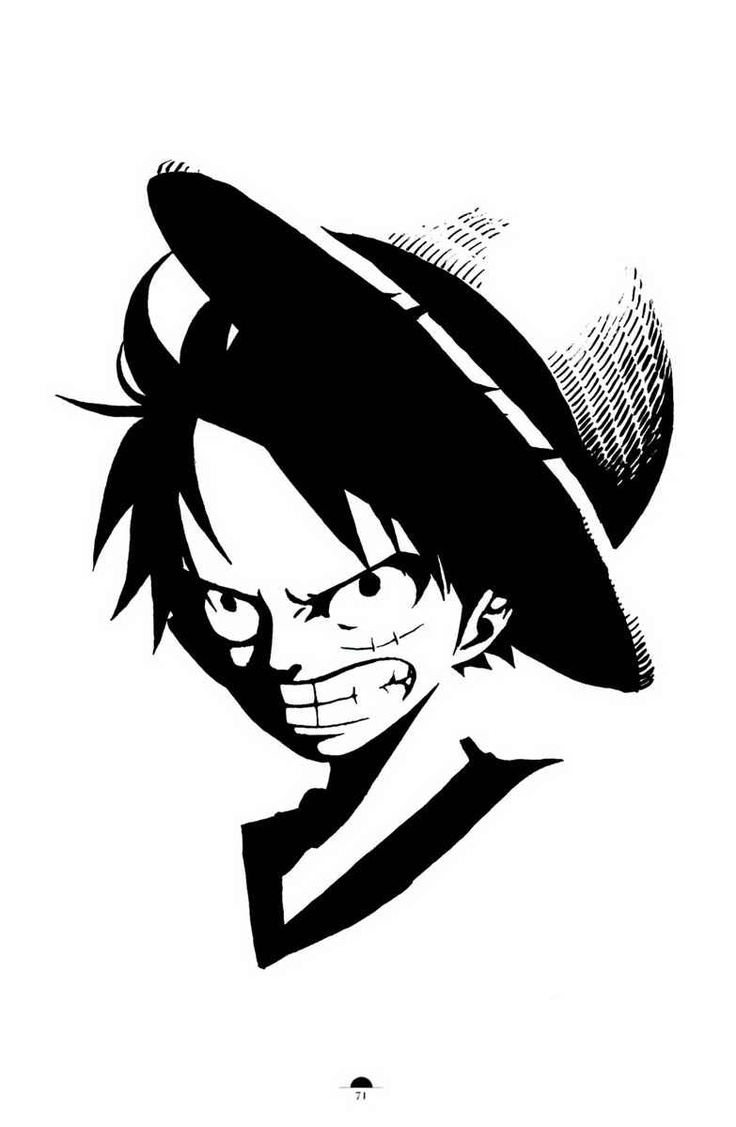 ?
?
Oda: I drew this one because the editorial office said they wanted something that looked like the cutout art on BOSS brand coffee cans. I was like, it’s not going to look as impressive, because Luffy doesn’t have a mustache (laughs).
Moderator: Are the pieces you draw for the cover of Shonen Jump dictated by the office?
Oda: For the Jump covers, I get instructions like, “We want a school sports festival theme, since it’s the fall.” But the people drawing the request on the simple form aren’t pro artists, so sometimes you get really crappy examples where you wonder, “What the heck does this mean?” (laughs) So I have some personal freedom within the constraints of the theme. I always have options.
Amano: Oh, so that’s how it works. Like, this is the general idea, and this is where the logo will go?
Oda: That’s right. And the color spreads, chapter covers, and volume covers are pretty much up to me.
Amano: Your characters all have such incredible energy. They’re very amped up.
Oda: There are times when even I can’t keep up with them. I have to tell myself, “I’ll wake up tomorrow and draw this when the sun is rising.”
Amano: You can really feel that propulsive motion in your work. It energizes you just by reading it.
Oda: Even as a student, I always felt like, “As long as I have an A in art, nothing else matters” (laughs). So when it comes to the story, I feel that as long as I get one really cool scene in there, I can manage the rest of it. For the rest, as long as I’m having fun, hopefully the readers will too. If anything, I don’t take it totally seriously until I have to.
Amano: Do the ideas for characters just flow out of you?
Oda: As far as the main group goes, I’ve always known how many there would be. I honestly thought it would take a year and a half to get them all together, but it’s been eight now, and I’m still not done.
Amano: This isn’t all of them? (laughs)
Oda: But when it comes to introducing them, my own sensibilities are different from when I started the series, and times change, so I’ve altered things from my original plan for them, bit by bit.
Amano: And you’re not tied down to any chronological period?
Oda: I try not to let there be a distinctive period to the story. So I never throw in references to the latest thing. I don’t want anything you could recognize that places the year I drew it. As long as I use just the classic tropes and the ideas that come from myself, I don’t think any of it will age too badly.
Amano: If you’re going to put in something that’s new, you have to digest it yourself first. Fashion changes every year, and if it’s from at least two years ago, it’s totally out of style. But in manga, you have it both ways. There are things that never change, and things that change constantly. How do you balance the two?
Oda: I think it just comes down to the author’s tastes. And then a good dose of luck.
Amano: I see.
Oda: And you never know if what you’ve created will last until later on. But I’m extremely confident that my sensibilities are normal.
Amano: I get that. It’s very important. (laughs)
Oda: Things that get popular do so because everyone thinks they’re good. So that way, I know that things I like will become popular.
Amano: Often it’s the stuff that you see when your eyes are totally honest that ends up being the cutting edge. If you look at a flower and you honestly think, “That’s beautiful,” you’re probably not going to go wrong in that opinion.
Moderator: Let’s finish this chat with encouragements for one another!
Oda: When I told people about this interview, they were surprised that I was a fan of your work. It’s probably because you can’t see your influence in my art. And I wouldn’t dare try to imitate it (laughs). I just want to keep gazing at the works you produce, so please continue doing your thing.
Amano: I think that a manga artist is like an athlete. You’ve really got to take care of your reflexes. You seem to have fantastic reflexes yourself, Oda, so don’t give in to the temptations of the real world, and keep finding ways to create your energetic stories!