Taiyo Matsumoto
Two suns are meeting in the sky at this moment!
Eiichiro Oda has an interview with Taiyo Matsumoto, an artist he’s always considered himself a huge fan of! With his unique art style and passionate stories, this titan of manga for adults will have much to say about creating works of art with Oda Sensei!
Moderator: Today we’re receiving a visit from Taiyo Matsumoto Sensei, whom Oda Sensei has been a huge fan of for years!
Oda: It’s so nice to meet you! I’ve read so many of your books, and I love them all. I’m very happy to get to meet you today.
Matsumoto: It’s nice to meet you too. It honestly feels like not a day goes by that you can leave the house and not see One Piece outside in one way or another.
Oda: I was really looking forward to today, wondering what kind of person you might be. In my head, you’re a very enigmatic fellow. You’ve drawn some darker material like Brothers of Japan, so I wondered if you might be very prickly and eccentric, but now that I meet you in person, you’re much more relaxed than I thought, and I think I very much see how this person could create that variety of stories.
Matsumoto: That book was something I made when I was very fascinated with ATG, and the very early works of Katsuhiro Otomo, you see. So was Blue Spring, actually. I’ve been given lots of leeway when working on short stories.
Oda: I used to think there was no such thing as a genius. I thought anyone who found success had simply worked harder at it than others. But after I read Ping Pong, I was like, “Oh, geniuses do exist.” You can’t draw manga like that with effort alone.
Matsumoto: Well, I do work hard too (laughs), but it’s very nice of you to say that. Thank you.
Oda: It’s just that your abilities of expression are unbelievable. The flow of panels just melts into you, and you can’t see the calculation behind them at all. It’s like you’re printing footage from inside your head, or just drawing on pure instinct, it feels like. What is your creative process like?
Matsumoto: Hmm… I don’t really recall. I was so busy back then that I don’t remember any of it. When I look at Ping Pong, I sometimes wonder, “Wait, did I really draw that?” On the other hand, I’ve been taking my time drawing Takemitsu Zamurai, so I remember it very clearly. Do you have any similar experiences?
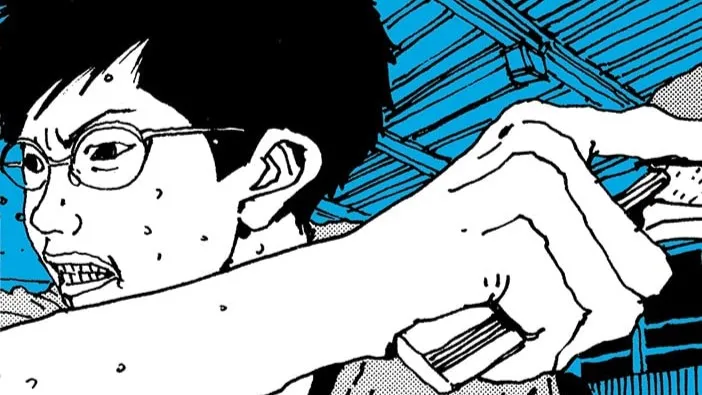
Oda: I understand what you mean. (laughs) When you draw without being aware of what’s going on, the results are just like that. Now, speaking of Takemitsu Zamurai, I love that manga. It’s just so cool. The pacing of the dialogue and the general sense of space are fantastic. I love the way you draw the protruding eye on the far side of the face, and the way you draw hands holding katana. In the scene where the main character cuts down an attacker, I thought, “Man, I wish I could draw something like this.”
Matsumoto: Ooh! Thank you. Then it was worth doing. It was a series that the readers hardly praised at all, so I finally feel as though I’m glad I drew it.
Moderator: Now I’d like to have Matsumoto Sensei give his thoughts on One Piece. How do you feel about the manga?
Matsumoto: I like that even the reader feels like they’re voyaging along with them.
Oda: Yes! I want it to be a kind of manga theme park where you get to enjoy a variety of experiences.
Matsumoto: Also, there were scenes like when the giants fight that seemed like they’d be very hard to put into art even if you had the image in your head. I found it impressive that you pulled those scenes off.
Oda: It is very hard, I’ll admit, but the idea I try to keep in mind as I go is, “I bet the readers will really enjoy this one.”
Moderator: Do you have a favorite One Piece character?
Matsumoto: I guess it’s probably Luffy. He’s an odd protagonist, isn’t he? You can’t really tell what he’s thinking.
Oda: With Luffy, I try to show, not tell. I make it a point not to give him dialogue that explains his entire train of thought. Perhaps doing that creates a certain sense of mystery to him.
Matsumoto: I feel like it’s been a long time since I came across such a manga-like work that’s overflowing with imagination and excitement. It makes you think, “Now this is manga!” I haven’t had many opportunities to read such material recently, so this feels fresh to me.
Oda: Is that so?
Matsumoto: The manga I seem to run across nowadays are often reporting on real-world things that have been painstakingly researched. Of course, I usually notice them because I like those.
Oda: It seems like that’s a common thing for manga for adults. In a shonen manga magazine, stories making full use of the imagination are still king. But it doesn’t mean that you can win over all the fans on your imagination alone. Even with fictional topics, you still need to do research. Do you gather research materials too?
Matsumoto: I will when I draw something about sports. But for fictional things, I generally don’t bother. Takemitsu Zamurai was a period piece, which I always wanted to draw but avoided because of the research involved. So when I got a writer to handle that part, I thought I could finally pull it off. I guess I don’t like stockpiling all those materials.
Oda: The first series of yours that I read was Tekkon Kinkreet, and that’s definitely got a lot of imagination in it.
Matsumoto: That’s one of my favorites, and reflects my own tastes better than any other. When I look back at it, there are points where I’m like, “I can’t believe I thought of this.”
Oda: I love how the kids run around with metal pipes, kicking ass. I used that in my own manga recently, in fact.
Moderator: You’re referring to Ace, Sabo, and Luffy as kids, right?
Oda: Yes. The decision to have them fight with pipes was influenced by Tekkon Kinkreet. It just felt like kids should be fighting with metal pipes! (laughs)
Matsumoto: Isn’t it hard to churn out nineteen pages every week?
Oda: It really is. Physically speaking, it’s getting harder to keep up the same level of work output. But there’s something about the momentum I get, the feeling of being cornered, that makes me feel like I’ll lose half of what makes my manga good if I allow for any slack at all. I’m actually hoping to cut down on the number of pages I produce each week… but I’m still trying to figure that out.
Matsumoto: I honestly just can’t put out close to twenty pages every week anymore.
Oda: Well, you pretty much draw all of the backgrounds yourself, too, so that takes time. But you’ve worked on weekly series before this, haven’t you?
Matsumoto: I have. Ping Pong and Tekkon were done on a weekly basis, but by the second half of Ping Pong, it was getting to the point where I needed to take breaks.Takemitsu Zamurai would run for three months, then go on break for three months so I could stockpile, so that made it easier to manage time.
Oda: Oh, I see. I think that extra time really has a good effect on the art itself. You can really see that relaxation in the way it’s drawn.
Matsumoto: Are you the type of person who just has to be busy?
Oda: I can’t help but put my hopes in the flashes of inspiration I get when I’m under pressure from deadlines. Once you have enough experience with coming up with great ideas and drawing really propulsive art at the last possible moment, you learn to rely on that instant burst of power. But pulling that out yourself also requires carefully placing yourself in tough situations. So the results is that it gets harder and harder.
Matsumoto: I can continue drawing as long as I get intervals to rest, but I’m just not suited to maintaining a continually intense mindset. On the other hand, if I had all the time in the world to make the best possible piece of work, I probably wouldn’t actually pan out.
Oda: What do you mean?
Matsumoto: I spent about three years working on a one-time, book-only piece called GoGo Monster, and it just didn’t go the way I wanted it to.
Oda: Wow! You drew this huge book all in one go?
Matsumoto: Yes. I decided my own deadlines as I was drawing, but it was even more different from drawing for a magazine than I realized. Partway through, I would think, “I can still quit now,” or, “I can redraw this if I want.” I wanted to just give up on the whole thing, but my editor convinced me to stay the course, and I only just barely brought myself to finish it.
Oda: Ah, I see. Still, I’m jealous that you got to put out such a beautiful book. I wish I could draw a whole book and put it out at once like that.
Matsumoto: The jacket illustration for GoGo Monster took me a lot of time to draw too. But I don’t feel like the quality of the finished work directly correlated with the amount of time. I mean, the cover for Ping Pong volume 1 only took me three hours from blank page to completion.
Oda: Three hours! (laughs)
Matsumoto: I had different design first, but they really wanted me to do something else, so the editor and book designer came to my studio. They said, “We’re going for a walk around Enoshima, so get it done before we return,” but that only left me with three hours. I barely had time to even pencil out first, much less color it, so I just whipped it up with pastels.
Oda: This is a great drawing. It’s full of motion. If you hadn’t told me, I would never have guessed it was drawn in three hours.
Matsumoto: But speaking of pressure, you can really tell from reading One Piece how intense the process of its creation is. I practically break out in a sweat just thinking from reading it.
Oda: I appreciate you saying that so much! It’s an incredible relief to know at least one person understands that!
Moderator: Matsumoto Sensei, your art style changes from series to series. Does this stem from your own personal preoccupations?
Matsumoto: If anything, I’d say the content of the story changes to match the art. To me, the art in manga is a tool to move the story and to help express it. So I don’t really have any unique preoccupations on how to do it, but I will admit that in Takemitsu Zamurai, for example, I’m trying to let the art dictate the work quite a lot.
Oda: It’s really incredible how some illustrations can tell you something with just a single illustration and not need story or context or narration to make it work.
Matsumoto: Exactly. I often feel that’s difficult to achieve when I do illustration work.
Oda: Pardon me for changing the subject, but do you use a computer when you draw?
Matsumoto: I don’t have a computer.
Oda: What? Isn’t that inconvenient, though?
Matsumoto: My family has one, so I don’t really suffer because of it.
Oda: So you don’t draw anything on the computer, then.
Matsumoto: You do pretty much everything by hand too, right?
Oda: Yes, although I do use one to draw the author’s portraits for individual volumes. But my computer’s also acting up lately. So everything is hand-drawn on paper.
Matsumoto: I like how you really get that hand-drawn sense from your art.
Oda: I feel the same about yours. There’s something about art you like that just feels right when you gaze at it. You can stare at it forever without getting tired of it. And then there’s art that looks nice, but you can only look at it for so long. I think that overall, hand-drawn art tends to fall into the former category, so that’s important to me.
Matsumoto: You’re about halfway through One Piece, right? How many years do you think it’ll take you to reach the finish?
Oda: It’s scary when you start to actually break it down, so I try not to think about it nowadays. (laughs) I don’t know how many years it will take, but I am going to reach the finish.
Matsumoto: Well, I hope that you get Luffy and his crew all the way to the end of the Grand Line.
Oda: Thank you! Every time you come out with a new manga, I feel as though you’re showing off some new drawer in your cabinet full of tricks. I can’t wait to see what’s coming up next.
Matsumoto: Actually, my next manga is starting very soon. It’s called Sunny, and it’s got a bunch of kids in it. It should look like this. (Pulls out copy to show Oda.)
Oda: Wow! So this is a pencil draft of your next comic! You put this much detail into your line work and backgrounds in pencil alone? Incredible. Do you do perspective on your backgrounds?
Matsumoto: No, I don’t. You can tell when I go to paste screentones, and all of a sudden things are way off.
Oda: No, it’s not a problem at all! Here we go, this is the kind of stuff you can’t produce with effort alone. This is fantastic. Thank you for showing it to me. I’m very much looking forward to it! I’m so glad I got the chance to meet you today. Thank you so much!