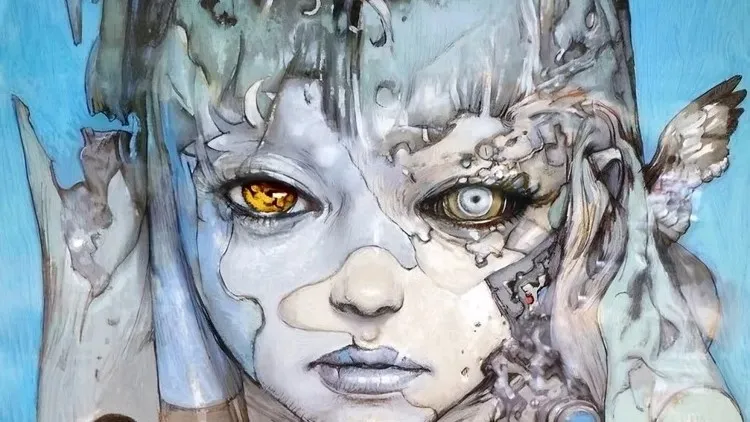
Katsuya Terada
Put your soul into each line!! A meeting between two men who live through art!
It’s a conversation between Eiichiro Oda and Katsuya Terada, who drew an illustration for One Piece: Ace’s Story! Read on as two artists who put their souls into drawing find their thoughts synchronized across boundaries, between manga and illustration, analog and digital!
Moderator: Today our guest is Katsuya Terada Sensei, who drew an illustration in collaboration with our Ace novel!
Oda: Thank you so much for coming! I felt intimidated on the way here, because your art is just so phenomenal. Your collaboration artbook with Kim Jung Gi blew me away.
Terada: Oh, please. You can be intimidated by Kim if you want, but there’s no need for that with me!
Oda: No, it’s true! I think anyone who does art would be intimidated by the name Katsuya Terada (laughs). I’m really happy we have the chance to sit down and have a nice conversation.
Moderator: Oda Sensei, tell us what appeals to you about Terada Sensei’s art.
Oda: I think the most impressive thing is the way he can describe characters and stories simply through visuals. In manga, you can build things up with dialogue and story flow, but in his case he tells you just as much without those things. And most of all, you can tell simply from looking at it that he’s really enjoying the creation of it. His art makes me excited to draw.
Terada: Thank you (bows). I think of myself as half manga artist, half illustrator. But the manga artist part is my dominant leg, if that makes sense. That’s why I want to create art that tells story, that has characterization. Like, I can’t draw someone’s face if I don’t know what they’re thinking.
Moderator: When you did the Ace illustration, what part of Ace struck you as being the coolest?
Terada: I would say… his face! He always looks great, no matter the situation. Basically, I took a bird’s-eye view of all of those faces, compared them to the varieties of handsome faces I can create, and came up with that piece. I guess you could compare the mental process I used to casting a film.
Oda: Oh, I see. Thank you so much for that awesome illustration!
Moderator: Terada Sensei, can you tell us what you like about Oda Sensei’s art?
Terada: I’m just going to be bold and ask straight up: are you a child of the Akira Toriyama generation?
Oda: Yes. (firmly)
Terada: Everyone grows up within the influences of the great artists who came before them, and the bigger that influence is, the harder it is to escape it. But within that system, you’ve always had your own worldview and perspective. And that’s why it’s not an imitation of Toriyama. Which is incredible. When you’re switching between doing manga and illustration work, does your process or your approach change at all?
Oda: It doesn’t. I treat illustrations and manga the same way, which is to say that I want to express the emotions and actions of the characters. Like I’m just slicing out a single moment of time where those things are visible. But I feel like I’ve long since finished drawing all the things I wanted to draw. That’s the biggest hurdle for me now. Do you ever get bored, Mr. Terada?
Terada: [Instantly] Yes! All the time! I want to draw things I’ve never drawn before, and find lines I’ve never found before. That’s always on my mind. But even within the same motif, sometimes the second time around, you can do things you couldn’t do the first time. Maybe you can draw a piece that surpasses what you drew before. So if you put your hopes on that, it might help you enjoy the process more.
Oda: That’s a good point! I agree. What illustrators and manga artists influenced you when you were younger?
Terada: I really loved the man who drew the Torzan covers for the Hayakawa SF line, whose name was Motoichiro Takebe, and a French comic artist named Moebius. I took a ton of influence from them.
Oda: Ooh. And Katsuhiro Otomo really loved Moebius too, didn’t he?
Terada: Right. In terms of generations, you’re probably more of a grandchild of their influence, but when I came across them at age fifteen, it was instantaneous. I’d collect back issues of imported magazines and pore over them. The text was in French, so I had no idea what was happening in the story. But the art was so incredible, I could imagine it was something grand and epic. Then a Japanese translation came out later, and it wasn’t at all what I expected it to be (laughs).
Oda: Like a misleading movie trailer.
Terada: But it’s like that for weekly manga too, isn’t it? You get the readers’ expectations up, then you give them something that’s beyond what they imagined and hoped for. It’s an amazing feat to do that consistently for such a long period of time.
Terada: I started reading Jump in third grade. The stories at the time were things like Mazinger Z, Dr. Toilet, and Manga Drifters. Tezuka Sensei drew for them too. When did you start reading it?
Oda: The same, third grade. Dragon Ball hadn’t started yet. It was all Kinnikuman, Fist of the North Star, and Captain Tsubasa.
Moderator: Terada Sensei, I understand you were an assistant to Masakazu Katsura Sensei during the Wingman days.
Terada: He was an upperclassman at my vocational school. We’re still in touch. I came to Tokyo to attend an art school, and I met Katsura at a new students’ welcoming party. He was dancing around in a tokusatsu hero costume, but the costume itself was incredibly high quality. I asked him, “Who made that?” And he said, “I did.” I was amazed.
Oda: So he already loved superheroes back then.
Terada: That’s how I met him, and then I assisted him just once at the start of his series. It was my job to erase the pencil, and I’d scrunch up the paper doing it. (laughs) That was the first time I saw a pro manga artist at work. I met Mr. Toriyama through Katsura too.
Oda: Oh! That’s interesting.
Terada: To me, manga is the highest conceptual form of entertainment. It’s like, whatever you can say about movies, one single person drew this manga for you! Ever since I was a boy, I wanted to make a living drawing. I ended up taking the path of an illustrator, but in my mind, I’m half manga artist. I just haven’t ever gotten past the stage of manga “rookie,” that’s all (laughs).
Oda: I think I understand why your art has so much character and story to it now.
Terada: As a kid, you never had any doubts about wanting to be a manga artist, did you?
Oda: That’s right.
Terada: I figured as much. Those are the type of people who end up actually becoming artists or manga artists.
Oda: I was hoping to pick your brain about working digitally today. What software do you use?
Terada: I used to use Painter, but now I use Procreate. Now that you can draw anywhere as long as you have an iPad Pro, it’s made working while overseas so much easier.
Oda: And what brushes?
Terada: Just the 6B pencil that comes with it. I fine-tune the strength as I go, that’s it.
Oda: I thought you must have had your own original brush settings… I’ve gotten really into collecting different brush tools lately.
Terada: I guess you can just try out different things and use the ones that suit your look the best.
Oda: I finally found a brush that feels right to me. I’ve been drawing on paper my whole career, but recently I’ve started getting into the habit of doing digital pieces for the various extra things Jump wants from me. It really feels like the digital tools are at a point where you can’t tell the difference between digital art and ink on paper. I really enjoy the time-lapse feature too.
Terada: That’s great. It’s surprisingly easy to make things that look way more laborious than they are (laughs).
Oda: When did you start working digitally?
Terada: When I was doing The Monkey King. The first chapter was done with Liquitex and Copics, and I switched to digital with the second chapter.
Oda: Drawing your color pages with digital tools is so standardized now, it’s hard to stand out. Yet you really have your own color and style.
Terada: If you use digital tools to make the process easier, your art’s going to feel flat. So most art, when I look at it, I think, “It’s lacking flavor.” But some people are good at it. When Toriyama switched to doing digital, it was still his art. I think you need to look at them as tools. Work digitally, but always have that thought in your head that you can do the same thing analog.
Moderator: With digital art, you can keep fixing and changing things indefinitely. It must be difficult to reach the point where you think, “It’s done!”
Terada: In my case, I usually decide on my palette first — my blue will be this shade of blue, and so on — and I don’t stray from that until I’m done. Because if you start thinking, “Well, I could use red instead,” you’re going to create too many possibilities, and you get stuck in the swamp of choice.
Moderator: What about you, Oda Sensei?
Oda: When I do color work on paper, there’s a physical limit to how much color changing you can do, so I don’t have to worry about it.
Terada: You don’t think about switching over to digital?
Oda: I’ve decided that I’ll draw the One Piece manga and its color pages with pen and paper until the end. I think that’s what the readers want too.
Terada: But the art supplies are drying up, bit by bit. What will you do if they stop selling Copic markers?
Oda: That would be bad. (laughs)
Terada: It might only be theoretical at this point, but you should consider the possibility that you might want to switch to digital for physical reasons. Drawing lines with a pen does require physical strength.
Oda: I’ve started wondering about that. How many years can I keep working with all of my strength like this? The reason I went ahead with the live-action One Piece show is because I thought this was the last moment I could do it. A few years from now, I won’t have the stamina to have tough conversations with production people overseas and perform quality checks. So I thought, “Now’s the time!” Do you think about a decade in the future, or have goals for yourself?
Terada: A decade from now…? No idea! But I want to be fit enough to keep drawing, and to not have my art weaken. I want to keep drawing forever. I’m fifty-four now. In the Edo period, I’d be retired already, and in the Warring States period, I’d be long dead (laughs). I’m grateful I was born in a time when I can live long, and I want to draw until it’s time to go. My goal is to surpass Hokusai Katsushika then! Staying healthy is the most important thing.
Moderator: Since you’re both here, we might as well ask: how do you get better at art?
Terada: Simple: keep drawing! But everyone always gets upset when you tell them that’s the answer (laughs).
Oda: They always want to hear about some special trick, or the perfect tool you can buy that will make it all work.
Terada: When I was a kid, I thought there was a shortcut to getting better too… but there wasn’t.
Oda: I think it can be hard to keep drawing when you’re a kid too. If you go to school and take art classes, they scrape away all the freewheeling ideas you have, and the unique touches that are your own.
Terada: I went to an art class when I was a little boy, and it wasn’t very much fun. But the thing is, art is 80 to 90 percent reason and logic. It’s that last part after that where your uniqueness comes out. But the unique part has to go on top of the foundation of skills, like being able to draw a proper curve or a straight line. So first things first, draw a lot. I’d say the majority of people who want to get good at art don’t even do that.
Oda: Uh-huh. I know how important it is to keep your hands busy. It’s when you’re busiest that you’ll draw the best lines. When you haven’t slept in a long time, that’s when you enter the “invincible zone” (laughs).
Terada: You really should sleep! (laughs) I’ve always been completely useless without sleep, even when I was young, so that’s never been a problem for me. One time I was trying not to fall asleep and accidentally wrote the numeral 5 as the kanji for seven. That freaked me out.
Oda: I once suddenly realized that I was drawing boobs on Luffy (laughs). Speaking of that, the girls you draw are so sexy and cute. Are there any specific people you use as a motif? Like, any celebrities or whoever?
Terada: There’s no specific person or model that I prefer to use as inspiration. There are faces I like, and that’s a different thing than what I would look for in a partner. I guess when I’m drawing, I tend to go for cool looks rather than desirable ones.
Oda: So if a woman who looked exactly like one of your drawings said, “Please marry me,” what would you do?
Terada: I’d… probably consider it (laughs). Are your favorite looks and the looks you draw the same thing, then?
Oda: Yes, they’re the same.
Terada: Well, you see, I started drawing women once I started getting jobs drawing the covers of erotic magazines. Until then, I didn’t really draw them very much. So it became a major theme with me back then that I’d try to draw a different face each time.
Moderator: So is observing women key to drawing them?
Terada: That’s true of everything, really. And you might examine a lot of women’s faces, but you don’t really commit them to memory. We’re drawing this art for entertainment purposes, so we want to draw beautiful women, of course. But if you’re not very clear about what the standards of that beauty are, you’ll end up a bit out of focus. Things like makeup styles change so quickly. If you’re focusing on the wrong things, you’ll end up drawing makeup rather than the actual faces of the women.
Oda: I completely agree.
Moderator: Lastly, a final message for each other.
Oda: I’ll go first. Like I mentioned earlier, seeing your art really just makes me want to draw. I hope you’re able to continue forever, without getting tired of it!
Terada: You said you’ll “keep on drawing One Piece like always,” but the truth is, things change. You can’t stop that. And I’m really looking forward to that change. You struggle with different things as you go, and get even better. I love watching artists evolve over time, and it’s a real treat to get to see that process unfolding. I really want to see you draw something that isn’t One Piece too, something that isn’t even recognizably Eiichiro Oda! So please, stay healthy (laughs).